Beyond the model: production systems.
Architecture, orchestration, tooling and backend engineering for production AI applications.
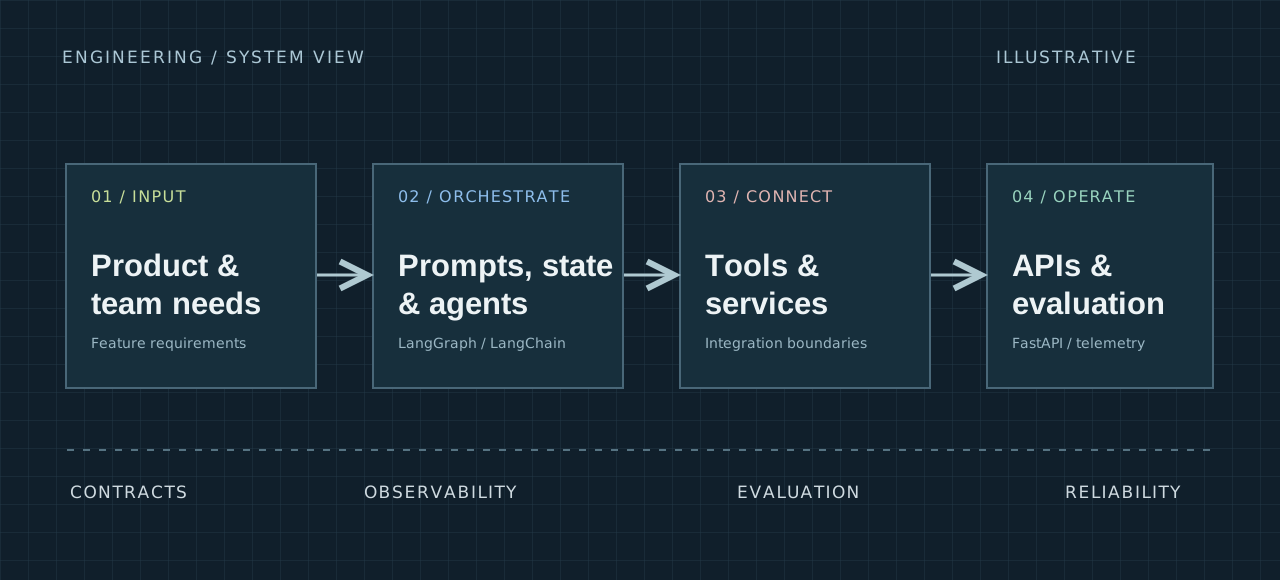 A SIMPLIFIED VIEW / NOT A CLIENT SYSTEM DIAGRAM
A new AI feature has to make sense inside the system that already exists.
Turning requirements from different teams into prompt designs and production architecture changes.
The part after the demo.
Through Gravitate AI, I've spent a substantial part of my time working on the AI systems behind TrustCloud's compliance platform. I talk with team leads across the product to understand what their AI features need, design the prompts and workflows, and implement the necessary changes in a LangChain, LangGraph and FastAPI codebase.
It's rarely just a question of getting a better answer from a model. A new feature can affect state, tool calls, service boundaries and the behaviour other teams already rely on. I spend a lot of time thinking through those interactions before and after writing the code.
From APIs to AI platforms.
Before and alongside the AI work, I've built plenty of ordinary software: Django business applications, Flask and FastAPI services, integrations and internal tools. That background turns out to be useful when an AI feature has to fit into an actual product.
On my own machines, I run local models with llama.cpp and Open WebUI, experiment with RAG and ChromaDB, and build small assistants. One connects a private knowledge base to Telegram; another was a hackathon meeting agent that could interact with GitHub issues. These are the projects where I get to try ideas quickly.
Areas of practice
- LLM application architecture, evaluation and prompt design.
- Agent and tool orchestration with LangGraph/LangChain.
- FastAPI and Python backend services.
- Self-hosted model inference, RAG and open-source AI infrastructure.
- Docker, Linux, networks and deployment operations.
Things I’m still exploring.
I've also been exploring indirect prompt injection, extracting quantum-circuit images from research papers for multimodal datasets, and historical digital twins with AGYA. Some are experiments and some are longer collaborations—I like keeping room for both.